
An Introduction
On finding a way to slow down, or what led me to start this online nature journal.

Pull on some boots
Grab a journal and pen
Ease on down to the water’s edge.
Notice a flower
Discover a web
Elderberry, hawk, watercress, sedge.
____
Look through binoculars
Trace the shape of a leaf
A riparian abundance of wonders to seek.
Pay attention to cycles
Embrace gratitude and grief
All this and more on a walk in the creek.
____
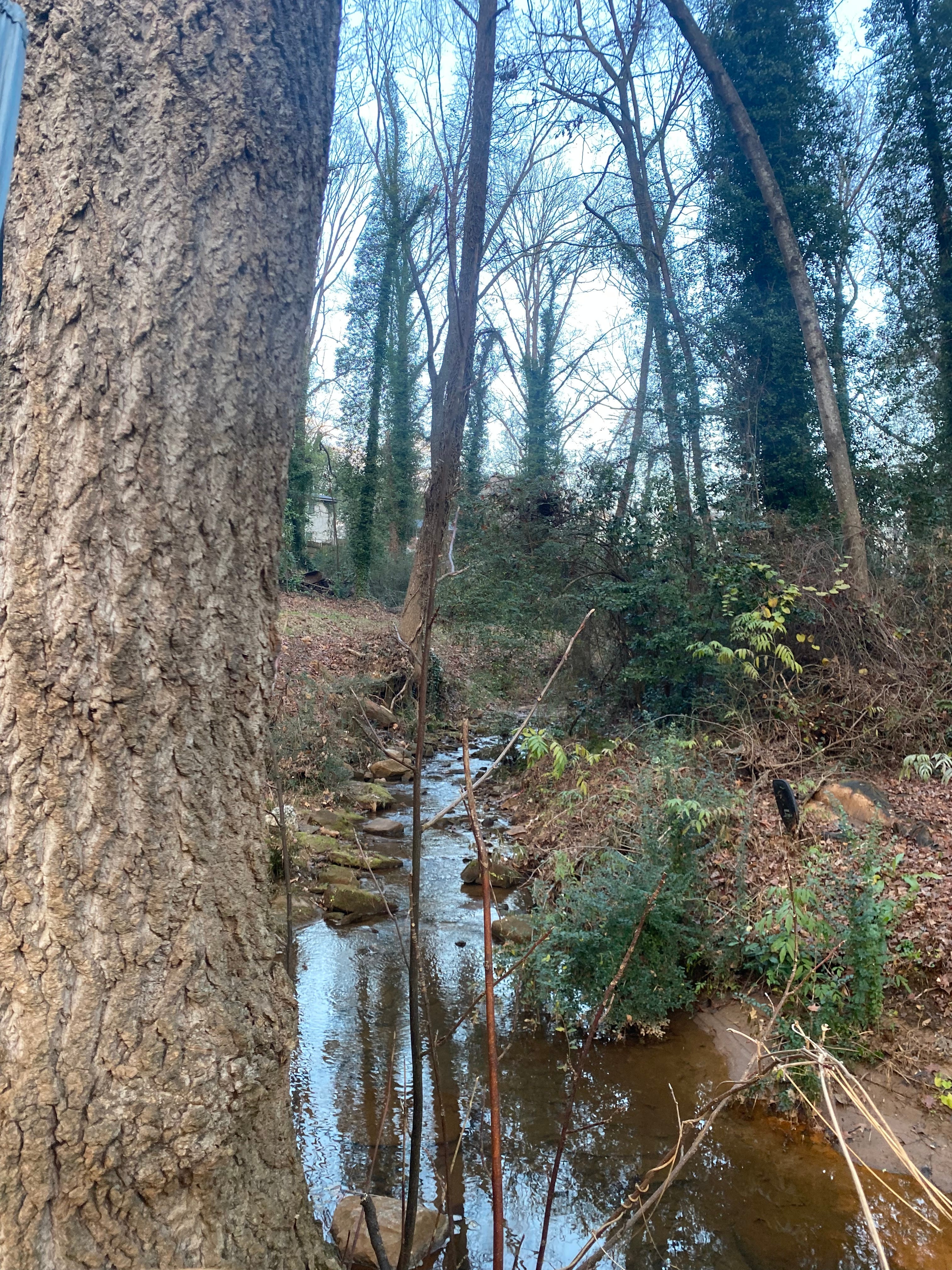
The idea came to me while riding the train home from work: the image of sloshing down a pebble-lined stream in black boots, a paper and pen in hand. And not just any stream, but the one flowing through my own neighborhood, hedged by towering trees and clinging kudzu vines. Like a scavenger hunt on a trail carved by water, ushering me into a slower pace of regular visits to the same creek bend.
On that particular evening, hurtling down the tracks through East Atlanta, I felt the urge to explore and write about an old path with a fresh perspective. Just that week I had lined up a work sabbatical from my land development engineering job, which felt like pushing against a strong current often at odds with patient observation and environmental stewardship. As an engineer, writer, and aspiring naturalist with an analytic, anxious mind, the prospect of a recurring walk in a creek felt like a light at the end of a tunnel, turning the margins of my life into the center.
Rebecca Solnit writes in Wanderlust: A History of Walking:
“Pilgrimage is premised on the idea that the sacred is not entirely immaterial but that there is a geography of spiritual power . . . it reconciles the spiritual and the material, for to go on pilgrimage is to make the body and its actions express the desires and beliefs of the soul. Pilgrimage unites belief with action, thinking with doing, and it makes sense that this harmony is achieved when the sacred has material presence and location.”
I admire thoughtful, imaginative writers like Annie Dillard, Wendell Berry and Robin Wall Kimmerer, who turn their everyday observations into fascinating narratives, telling stories of how they are shaped by their surroundings, of organic encounters that transform the ordinary into holy ground. Like them, I want to explore an ancient road less traveled, not aspiring to long distances but the same short path traveled repeatedly, my senses trained to minute details. A pilgrimage of nature journaling, rooted in a stream bank.
Moving at a conscientious pace also allows for noticing the movement of other beings. In Fen, Bog & Swamp, Annie Proulx writes about our modern inability to slow down and pay attention to the natural world. “To observe gradual change takes years of repetitive passage through specific regions week after week, season after season, noting sprout, bloom and decay, observing the local fauna, absorbing the rise and fall of waters, looking carefully— the way all early humans lived.”
Over the last decade, walking has become an integral way for me to “slow down” in a harried culture. The instinctive motion of my feet along a familiar path lets my mind disentangle from rumination and wander freely. I am thankful for quiet paths winding through an oak-pine-hickory forest or the wide roads cutting through my eighty-year-old neighborhood. In our age of TikTok, automated vehicles and GPS navigation, aimless, leg-powered travel is a miraculous, humane endeavor.
In this next season, why not turn my feet toward even more natural paths? A creek is, after all, a path—not specifically made for humans, but affected by us nonetheless. “Rivers are ‘good to think with,’” writes anthropologist James C. Scott. They offer “a striking example of the consequences of human intervention in trying to control and domesticate a natural process, the complexity and variability of which we barely understand.” Scott describes streams as a moving connective tissue, a conveyor belt of sediment and seeds and microscopic organisms, just as much as a pathway for water.
In my backyard there is an aquatic course from the Atlanta Metro area to the Atlantic Ocean, beginning near the “Continental Divide.” And rivers can move in more than one direction. They have an amorphous width, a periodic swell of floodwaters beyond incised banks. What about the land flanking the waterway, is it also part of the creek? And anywhere a raindrop hits the ground and flows down, down to a concentrated channel? While knowing what is upstream and downstream and of a creek is crucial context, I plan for my walks to be up close and personal, focused on a paraticular reach of a stream, slowed by the uneven terrain of rocks and tree roots, my feet following a path not made of pavement but of earth and water and time.
I want to keep this as simple as possible: wade in the flowing water in my backyard at least twice a month, for at least a year. Follow my curiosity, either upstream or downstream, seeing the familiar in a new light. Learn from the beings and patterns and relationships around me. Make note of what captures my attention, what joins the flow of my thoughts, even as the weather and seasons change, even as the direction of my life is in flux while I try to decipher what steps to take next.
In these visits I will prioritize patience, minimizing disturbance by moving carefully, responding with at least one small act of stewardship, and bringing along simple tools to sharpen my senses, like binoculars, an app for plant identification or a magnifying glass.
Perhaps a stream isn’t “meant” for me to walk in. Well, my species is already sending excess rainfall down this waterway by covering the ground with pavement, letting plastic wrappers from our gadgets and packaged meals wash into this corridor, discharging tainted sewage through fragile pipes flowing alongside its course. After all these contributions, what more could my footsteps do but bring me closer, confronting me with the creek’s character, teaching me to respect the vulnerability of what is hidden, to recognize our shared fate.
Naturalist and author J. Drew Lanham came to a similar conclusion in his memoir, The Home Place:
“I eventually realized that to make a difference I had to step outside, into creation, and refocus on the roots of my passion. If an ounce of soil, a sparrow, or an acre of forest is to remain then we must all push things forward. To save wildlife and wild places the traction has to come not from the regurgitation of bad-news data but from the poets, prophets, professors and presidents who have always dared to inspire. Heart and mind cannot be exclusive of one another in the fight to save anything.”
My goals for this nature journaling activity are to:
Slow down, externally and internally, embracing patience.
Follow curiosity as a pathway to learning and storytelling.
Practice wonder using all of my senses.
Learn the names and characteristics of the plants, animals, insects and geology I come across.
Use different formats of writing to convey my experience.
Process my own changing life as I notice small changes in the stream across seasons.
Build my understanding of watersheds (the patterns and boundaries within which water moves across landscapes) and how these regions relate to ecosystems, cities, maps, history, safety, beauty, recreation and danger.
Recognize the impact humans have on small creeks, especially on the “hidden things” within them.
Consider multimodal avenues of transit, recognizing that humans are not the main or only species moving along corridors, taking journeys from here to there.
Pay attention as a way to love and engage in stewardship, to respond to what I learn with respectful care, adjusting how I live based on the consequences I notice.
Thank you for following along with A Walk in the Creek! May it lead you on your own, mundane, life-altering adventures.
I like this idea. I have a neighborhood creek in East Point, and although I've tried setting goals (visit or document or eBird or clean up trash on a regular schedule), I haven't been able to stick with it. It's partly that the trash situation gets so discouraging. I look forward to following your progress!